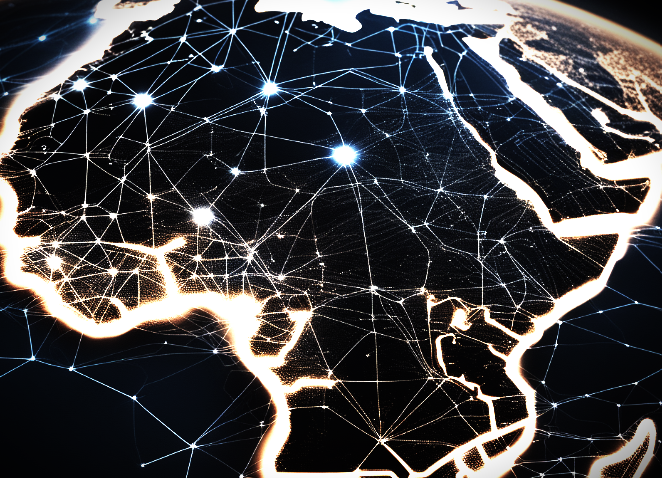
The digital divide in Africa is not limited to Internet access; it also reflects economic, social and territorial inequalities that restrict access to education, employment and public services, making digital inclusion a key issue for sustainable development and social justice.
Digital access is expanding rapidly across Africa, yet this transformation remains deeply unequal. According to the International Telecommunication Union (ITU), only 38% of Africa’s population used the Internet in 2024, compared with 68% globally. However, this continental average masks significant disparities—not only between countries, but also between urban and rural populations, men and women, and younger and older people. The digital divide is therefore increasingly recognised as more than a technological challenge; it is becoming another dimension of social and economic inequality.
The first dimension of the digital divide concerns access. In 2024, high-speed mobile networks covered approximately 86% of Africa’s population, yet this coverage did not mean that everyone could actually use the Internet. In rural areas, 25% of the population remained beyond the reach of high-speed mobile networks. The urban-rural gap was also significant: Internet usage stood at 57% in urban areas, compared with just 23% in rural areas. These disparities demonstrate that the digital divide is not limited to infrastructure availability; it also depends on connection quality, the affordability of devices and services, and people’s ability to access and use digital technologies.
An economic divide further compounds these geographical disparities. Being within network coverage does not necessarily mean having the financial means to connect regularly. The cost of mobile data, smartphones and other digital devices remains a major obstacle in many African countries. The World Bank has highlighted the cost of devices and Internet access as significant barriers to digital inclusion, particularly for low-income populations. As a result, the poorest households risk being increasingly marginalized in an economy where economic activities, employment opportunities and access to essential services increasingly depend on digital technologies.
This situation has direct consequences for education. Access to online courses, digital libraries, vocational training and educational resources increasingly depends on having a reliable Internet connection and a suitable device. The United Nations Development Programme (UNDP) highlights the scale of Africa’s educational needs, particularly given that nearly 60% of the continent’s population is under the age of 25, while digital infrastructure remains unevenly developed. These challenges complicate the expansion of digital education and risk widening existing inequalities in access to learning opportunities. Educational technologies can therefore be powerful tools for reducing inequality, but only if students have the necessary resources to access and use them.
The digital divide also affects employment and income. Digital transformation creates new opportunities in services, commerce, the creative industries, technology and remote work. However, people who lack affordable connectivity or the necessary digital skills risk being excluded from these opportunities. Digital transformation can be a key driver of job creation and poverty reduction in Africa. Yet, inequalities in access to the Internet and digital technologies continue to prevent part of the population from fully benefiting from the economic opportunities they offer.
The stakes also extend to access to information and public services. As government agencies expand their digital services, the ability to complete administrative procedures, obtain essential information or access public services increasingly depends on Internet connectivity and digital skills. Digital public infrastructure offers opportunities to improve service delivery and broaden economic opportunities across Africa. However, this trend also carries a risk: if digitalization advances faster than digital inclusion, it could create new forms of exclusion, particularly for low-income citizens, rural populations and those with limited digital skills.
Finally, the digital divide has a civic and democratic dimension. The Internet has become an important space for accessing information, debating public issues, organizing collective action, communicating with institutions and participating in public life. Consequently, people who remain persistently offline have fewer opportunities to engage in these emerging spaces for civic participation. However, digital inclusion cannot be reduced to simply providing an Internet connection. The International Telecommunication Union (ITU) emphasizes the importance of “universal and meaningful connectivity,” which depends on several conditions: network availability and quality, affordable services, access to suitable devices, digital skills and user security.
The African digital divide must therefore be understood as a social divide that extends into the digital realm. The main challenge is no longer merely connecting populations, but ensuring that connectivity genuinely creates comparable opportunities to learn, work, stay informed, and participate in society. ITU figures reveal the scale of the problem: with only 38% of the population using the Internet in 2024, Africa remains the region with the lowest Internet usage. Priority should thus be given to rural areas and low-income populations, while also fostering digital skills and access for women. Bridging the digital divide is therefore not just a matter of technology policy; it is a policy for reducing social inequalities and fostering human development.